Jean-Marc Superville Sovak:
Open for Unfinished Business
The Dorsky Museum at SUNY New Paltz
September 9 – December 6, 2026
What do lovers of regional history do when we encounter gaps – omissions through tragedy or intention – in the historic record?
Historians have long sought to fill such gaps, searching for overlooked primary documents as well as revisiting known records with new perspectives and questions. These efforts have expanded the historic narrative, made it more inclusive, uncovered and corrected errors in the analysis of historic documents, and produced engaging new articles, books, and historical exhibitions.
But “life” in history – like the present – contains far more than what might appear in official records and written accounts. There is the unwritten record of lives and events passed down through stories or encoded in the material record of things created and left behind. Perhaps artists, working across disciplines and media, can best help us explore those lived experiences left out of the records.
In creating work for the exhibition now on view at the Samuel Dorsky Museum of Art on the SUNY New Paltz campus, artist Jean-Marc Superville Sovak approached the museum as a “site of interpretation and repair” where he sought to explore the lives and legacies of the Black community in New Paltz which has been largely absent in the material and interpretation of the town’s historic record.
Obeah/Boeman, 2026
One of the origins of the show (which includes new and collaborative works as well as a retrospective of Superville Sovak’s earlier work) was a series of watercolor paintings by an artist who lived in the Abraham Hasbrouck house in the 1930s. The exhibit includes nine original watercolors by Ivar Elis Evers as well as nine versions of the same re-worked by Superville Sovak. The original painting which inspired these “interventions” is an interior of the house where Evers lived which includes the shadow of a seated woman cast on the wall behind an empty chair. According to local legend, the house is haunted by the ghost of an enslaved woman grieving the loss of her child. The human remains of a child were discovered in the basement during 20th century renovations of the house, providing additional substance to this legend. There are no notes accompanying the collection to reveal Evers’ experience or intent with his painting, but Superville Sovak builds upon what is known by superimposing the handwriting of one “Black Huguenot” and the unfinished portrait of another to further solidify this history.
An example of Superville Sovak’s interdisciplinary and collaborative methodology, this work incorporates an existing collection of paintings from the Dorksy Museum’s holdings, as well as historic photographs and glass plate negatives from Historic Huguenot Street (HHS) and historic manuscripts from the Elting Memorial Library (Elting). Displayed nearby, “Studio Portrait of Ceasar c.1860” (HHS) is a formal photograph of a Black man in fine dress, while the photograph “Margaret Clow holding Jesse Elting DuBois, c.1900” (HHS) attests to the intertwined history of Black and white Huguenots in New Paltz. Also on display, John Hasbrouck’s “Account Book (2), 1837-1863” (Elting) was a source of inspiration and direct quotations for Superville Sovak to incorporate into his own work.
The Elting Memorial Library has digitized this primary document which can be accessed online.
Superville Sovak acknowledges a long list of collaborators for the show which includes artists, historians, and community members who assisted in his exploration of histories written, unwritten, built, buried, and embodied. They worked with archives, historic sites and museums, libraries, and churches and followed Superville Sovak’s guidance which curator Sofia Thiệu D’Amico recounted as “go talk to the people,” while seeking to expand and deepen the historic record of the community which the artist identifies as “the Black Huguenots.”
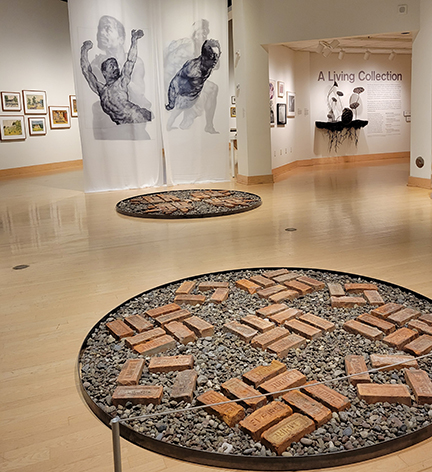
Including drawings, paintings, historic prints hand-altered by the artist, sculpture, assemblage, video, the exhibition serves as a retrospective of recent work and includes many new and collaborative pieces by the artist as well as archival materials from local institutions. Open for Unfinished Business is open through early December.